
On Why Centralised Alternatives Fail — and Why a Decentralised Registry Is the Only Viable Path
As IPv4 exhaustion rendered the original allocation role of Regional Internet Registries obsolete, a recurring question emerged: should RIRs continue to exist, and if so, in what form? Various alternatives have been proposed—state control, intergovernmental bodies, or treaty-based institutions modeled after organizations like the IAEA. All of these proposals share the same flaw: they attempt to solve a simple technical problem by adding political and bureaucratic complexity.

Why Buying IP Addresses Today Is a Scam — and How Telecoms Could Become Trillion-Dollar Companies
IPv4 addresses are widely treated as assets, traded for billions of dollars by cloud giants and telecom operators. Amazon alone has acquired close to one hundred million IPv4 addresses. Alibaba, Tencent, Huawei, and others have spent hundreds of millions, if not billions, doing the same. Yet there is a detail most boards and CFOs miss: none of those companies actually o
On Portability of Number Resources and the ICP-2 Revision
The revision of ICP-2 presents an opportunity to fix a structural weakness in Internet governance: the lack of guaranteed portability of number resources. Portability means that a network must have the unconditional right to move its IP addresses or ASNs from one Regional Internet Registry to another. This should not be optional, conditional, or discretionary; it must be a hard requirement embedded in ICP-2. Without portability, networks are effectively locked into the RIR they first registered with and are forced to bear the consequences of that RIR’s governance failures or operational breakdowns. That dependency creates systemic risk for the Internet itself.

On Decentralising the Internet’s Governance
The Internet today still relies on legacy structures that allocate and register critical identifiers—names and numbers—through centralised institutions that predate modern decentralised technology. These institutions, known as Regional Internet Registries, were created when the network was small and technical collaboration was informal. As the Internet matured into a global utility, the centralised control of identifiers became a structural vulnerability: a choke point susceptible to power capture, opaque governance and political pressure.

On Data Sovereignty: Technical vs Practical Realities
Global discussions on data sovereignty often confuse technical ideals with operational realities. At the Interconnect World Forum 2025 in Tokyo, I highlighted a core truth: enforceability of national data localisation laws is limited in a global digital economy where data flows everywhere and no single jurisdiction can physically contain connectivity.
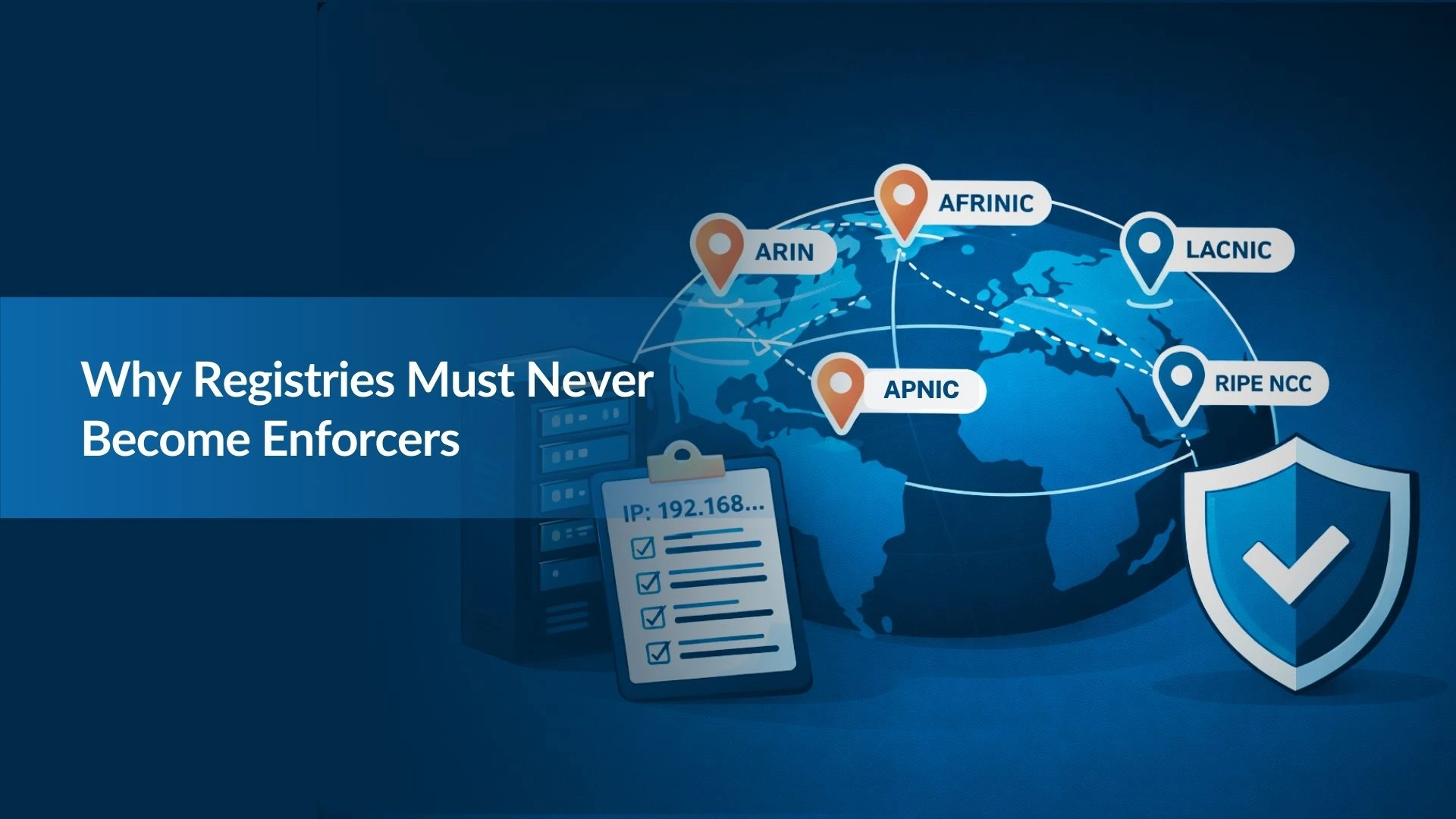
Why Registries Must Never Become Enforcers
A registry’s role is administrative, not punitive. Confusing the two is one of the most dangerous mistakes in Internet governance.
A registry exists to maintain accurate records: who is using which number, and under what documented procedures. It is, in essence, an address book. Asking such an institution to police behavior, impose penalties, or “punish” participants is a category error. You do not use an address book as an instrument of enforcement.
On Decentralising IP Addresses
The Internet has been steadily moving toward decentralisation for decades. From infrastructure to applications, from blockchain to Web3, almost every layer is reducing single points of control. Yet one critical layer remains stubbornly centralised: names and numbers—domain names and IP addresses. This is not a philosophical issue but a structural risk. Any centralised choke point can be captured, politicised, or abused, and when that happens, the Internet fragments.
The Internet’s Address Book — and Why “Digital Sovereignty” Is a Dangerous Fantasy
The Internet is often discussed as if it were a territory that can be owned, controlled, or conquered. This is a fundamental misunderstanding.
On AFRINIC, RIR Governance, and the Myth of “Community Ownership”
I write this note not as a commentator, but as someone who has been directly involved in the realities of Regional Internet Registry (RIR) governance, particularly at AFRINIC.