Why Buying IP Addresses Today Is a Scam — and How Telecoms Could Become Trillion-Dollar Companies
IPv4 addresses are widely treated as assets, traded for billions of dollars by cloud giants and telecom operators. Amazon alone has acquired close to one hundred million IPv4 addresses. Alibaba, Tencent, Huawei, and others have spent hundreds of millions, if not billions, doing the same. Yet there is a detail most boards and CFOs miss: none of those companies actually own what they paid for.
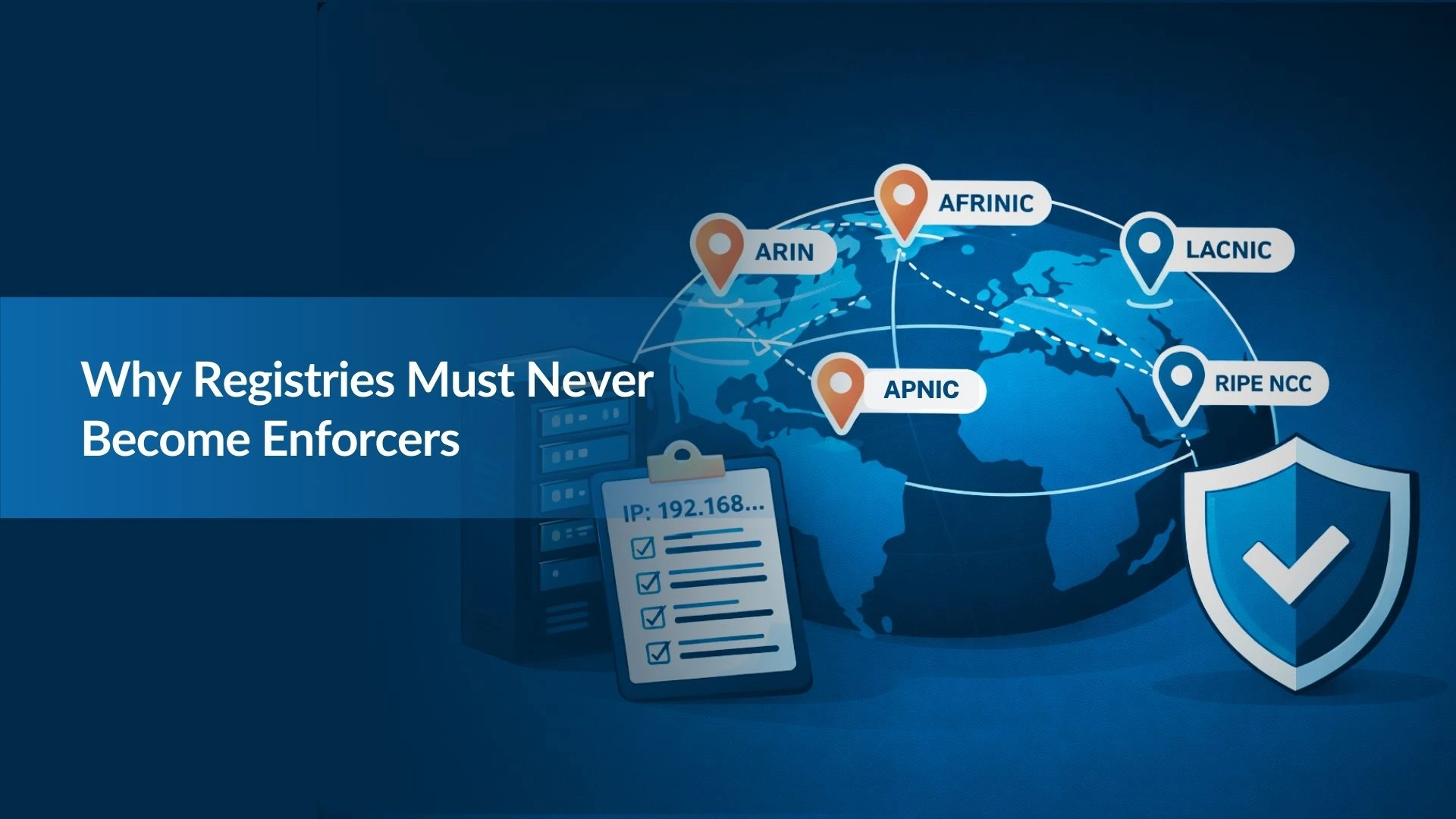
Under every Regional Internet Registry (RIR) agreement—ARIN, RIPE NCC, APNIC, LACNIC, and AFRINIC—IP addresses are explicitly _not_ property. What organizations receive is a service relationship: a registration in a database maintained by a private entity. There is no guarantee of perpetual ownership. Legally and structurally, what companies believe they “bought” is in fact a long-term lease, subject to policy change and unilateral action by the registry. Paying decades’ worth of fees upfront for something that can be revoked is not ownership. It is a mispriced lease. That is why buying IP addresses today, as the system stands, is effectively a scam.
The original role of the RIRs—distributing IPv4 space—ended more than a decade ago. Exhaustion forced the emergence of a secondary market, where IPv4 addresses now trade at fifty dollars or more per IP. Companies like mine fill the gap by leasing addresses where registries can no longer allocate them. But even the secondary market is constrained, because true ownership is not recognized. Liquidity remains artificial, capped by policy rather than economics.
Now consider what happens if ownership were fully recognized. If IPv4 addresses belonged to the networks that use them, rather than being controlled through five non-overlapping monopolies, the market would unlock entirely. IP addresses are service enablers: a thirty-cent-per-month IP can support a three-hundred-dollar cloud service. That is a 0.1% input enabling the entire business. If that enabler were priced closer to its true economic value, the balance sheets of telecoms would change overnight. The market capitalization of many operators would multiply, not through speculation, but by recognizing assets they already depend on.
This is not abstract theory. Take a major backbone operator with tens of millions of IPv4 addresses. At today’s valuations, the IP holdings alone can rival or exceed the company’s entire market capitalization. Under a regime of full ownership and liquidity, those same holdings would be worth orders of magnitude more. Telecoms would not merely be service providers; they would be among the largest digital asset holders on the planet.
There is also a security dimension. As long as IP addresses are treated as registry-controlled privileges rather than owned assets, the Internet has a built-in choke point. Five private organizations effectively sit above every national network. Without ownership, an ISP or even a country’s Internet can be disabled by policy or governance failure elsewhere. That is an unacceptable risk for critical infrastructure.
The policy path forward does not require instant revolution. It requires a first step: mandatory portability of number resources. If a registry performs poorly, behaves abusively, or becomes politically compromised, networks must have the unconditional right to move their registrations to another RIR. Portability introduces competition. Competition forces accountability. And accountability is the prerequisite for any credible claim of stewardship. Portability is the bridge between today’s lease-based system and tomorrow’s ownership-based one.
The Internet grew to its current scale because of decentralization, privatization, and market forces—not centralized control. Continuing to treat the unique registration of IP addresses as a monopoly function contradicts every successful principle of Internet growth. Ownership of number resources is not radical; it is overdue.
If telecoms want security, if governments want resilience, and if the Internet is to remain decentralized rather than governed by choke points, IP addresses must be recognized for what they already are: foundational assets. The choice is simple. Continue pretending that leasing is ownership, or correct the structure and unlock the largest wealth creation the infrastructure sector has ever seen.