On the Upper Potential of IPv4 as an Investment Asset
IPv4 addresses remain one of the most undervalued assets in the global digital economy. Their suppressed valuation is not accidental; it is structural. And that suppression directly translates into suppressed valuations for ISPs and infrastructure businesses worldwide.
IPv4 is a finite resource. With a 32-bit space, fewer than 4.3 billion addresses exist, and barely over 3 billion are actually usable. That scarcity is already real. More than a decade ago, Microsoft’s purchase from Nortel priced IPv4 at around $11 per address. Today, market prices have reached $50–60 per IP. Yet even at these levels, IPv4 remains dramatically undervalued.
The reason is simple: IPv4 is a _service enabler_. You cannot operate online without it. In every other industry, service enablers—city-center locations, spectrum, access rights—capture a meaningful share of the revenue they enable, often around 30%. IPv4 does not. A typical cloud server costing $200–300 per month relies on a single IPv4 address that costs roughly $0.25–0.50 per month. That is about 0.1% of the value it enables. No other critical enabler in any mature market is priced that low.
This gap implies enormous upside. Even a partial convergence toward typical enabler economics would mean IPv4 prices increasing by 100x or more. And despite today’s artificially low prices, IPv4 holdings already represent between 5% and 30% of the market capitalisation of many large telecom operators. The asset is already material—just not fairly priced.
Why is IPv4 so undervalued? Three structural constraints suppress its value.
First, liquidity. The global IPv4 market is worth roughly $100–200 billion, yet annual transfer volume is under $2 billion. That is less than 1% liquidity per year. No asset can achieve fair price discovery under such conditions.
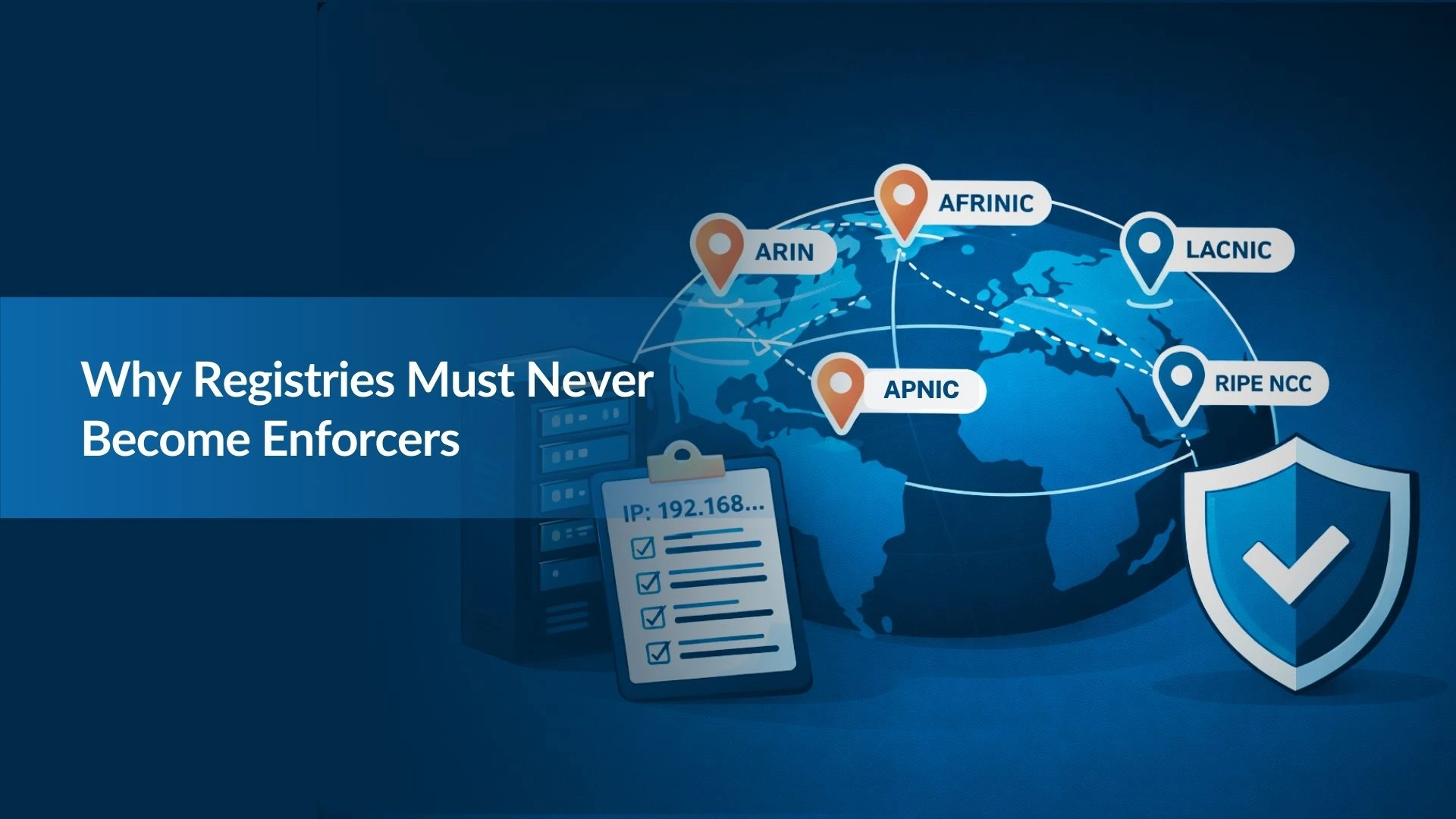
Second, policy barriers. Mandatory holding periods and “needs tests” imposed by Regional Internet Registries restrict free transfer. In any normal market, capital itself demonstrates need. Requiring additional justification after millions of dollars have already been committed is bureaucratic, inefficient, and vulnerable to abuse.
Third, ownership ambiguity. Buyers pay millions, yet registries insist the addresses are not truly owned and cannot be freely resold. This is not how real assets function. Without ownership, markets cannot mature.
Together, these constraints suppress not just IPv4 prices, but the valuations of the businesses that rely on them. Every ISP is an IP holder. Every ISP’s balance sheet is affected.
The conclusion is unavoidable: freeing IPv4 liquidity and recognising true ownership would unlock one of the largest wealth-creation events the infrastructure sector has ever seen. This is not speculation; it is the correction of a policy-induced distortion.
That change will not happen passively. It requires operators, executives, boards, and shareholders to engage directly in number-resource governance—to remove artificial barriers, demand efficient registry operations, and insist on fair asset treatment.
The Internet’s infrastructure industry has built immense global value while capturing only a fraction of it. IPv4 represents an opportunity to rebalance that equation. The question is not whether the value exists, but whether the industry will act collectively to realise it.