CEO of LARUS Limited and founder of the LARUS Foundation. He works at the intersection of Internet infrastructure, IP address markets, and global Internet governance, drawing on direct involvement across all five Regional Internet Registries. These notes aim to clarify how number resources are governed in practice and advance a more accountable, resilient framework for critical IP assets.
The Internet has been steadily moving toward decentralisation for decades. From infrastructure to applications, from blockchain to Web3, almost every layer is reducing single points of control. Yet one critical layer remains stubbornly centralised: names and numbers—domain names and IP addresses. This is not a philosophical issue but a structural risk. Any centralised choke point can be captured, politicised, or abused, and when that happens, the Internet fragments.
The founders of the Internet did not decentralise this layer because the technology did not exist and the Internet itself was small. Today, it is a global public utility. The old assumptions no longer hold. Centralised registries now represent a vulnerability: if the institutions managing registration databases act improperly, or fall under political pressure, they can threaten connectivity, neutrality, and trust. That danger is not theoretical; recent events at several registries have demonstrated it clearly.
The debate over whether IP addresses and domain names are “commercialised” is already settled. Markets exist and have existed for decades. The real question is ownership and control. A system where users are permanently subject to a central authority—with limited rights and weak remedies—is fragile. A system where each network owns or securely controls its own registrations is resilient. When everyone runs their own piece of the Internet, there is no single power worth capturing.
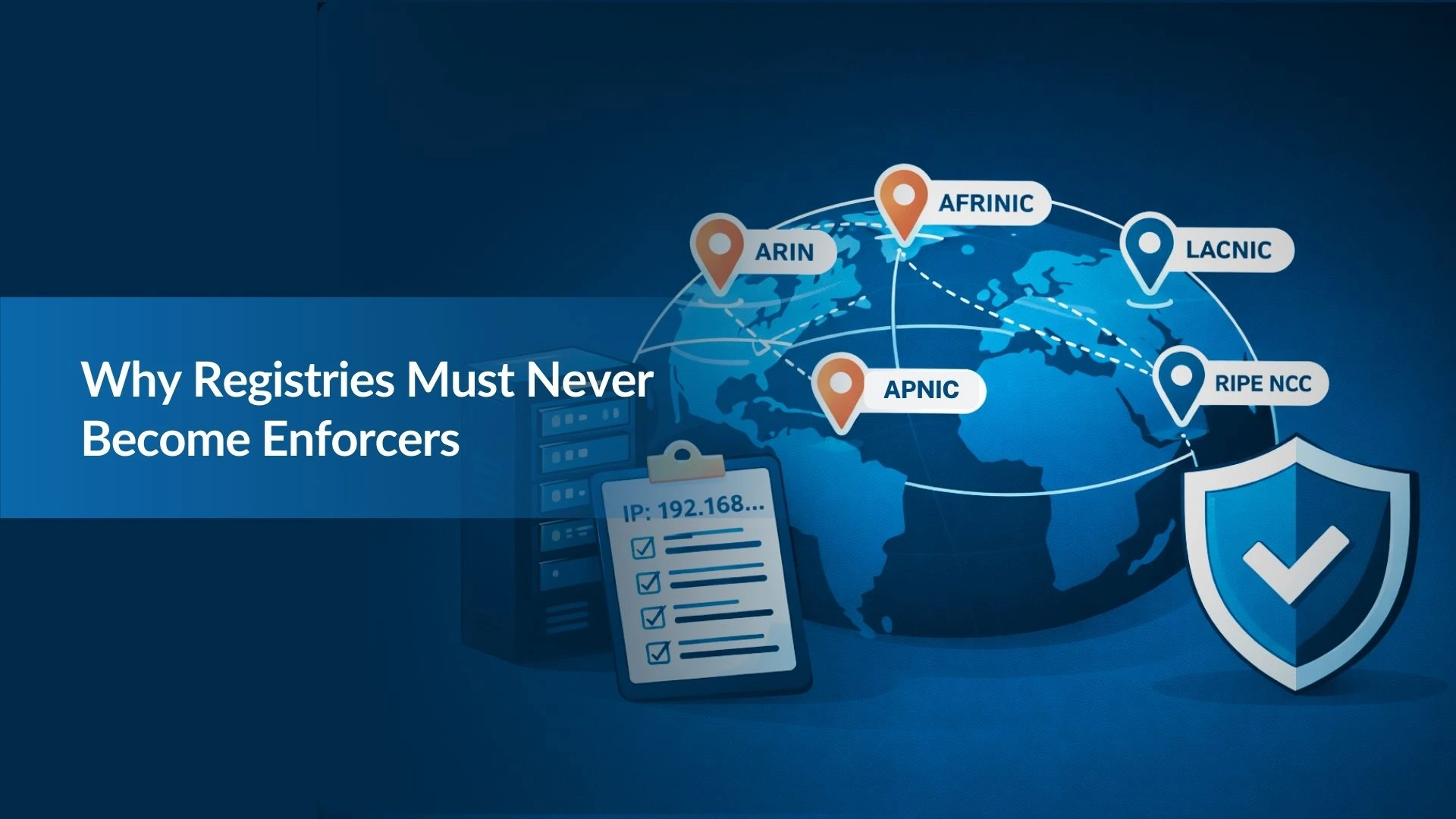
Decentralisation does not mean chaos. Until a fully decentralised model exists, the Regional Internet Registries must remain stable and neutral. AFRINIC, like the other RIRs, must be preserved in the short term because the Internet still depends on uniqueness and coordination. But in the long term, no institution should permanently hold monopolistic power over the Internet’s core identifiers.
My position has never been about money or control. Markets will exist regardless. What may not survive is a single, open, global Internet if centralised authority continues to be politicised and abused. A decentralised Internet—where power is distributed by design rather than constrained by promises—is not ideological. It is necessary if the Internet is to remain one network for the next generation.