On Decentralising Global IP Address Registration with Distributed Ledger Technology
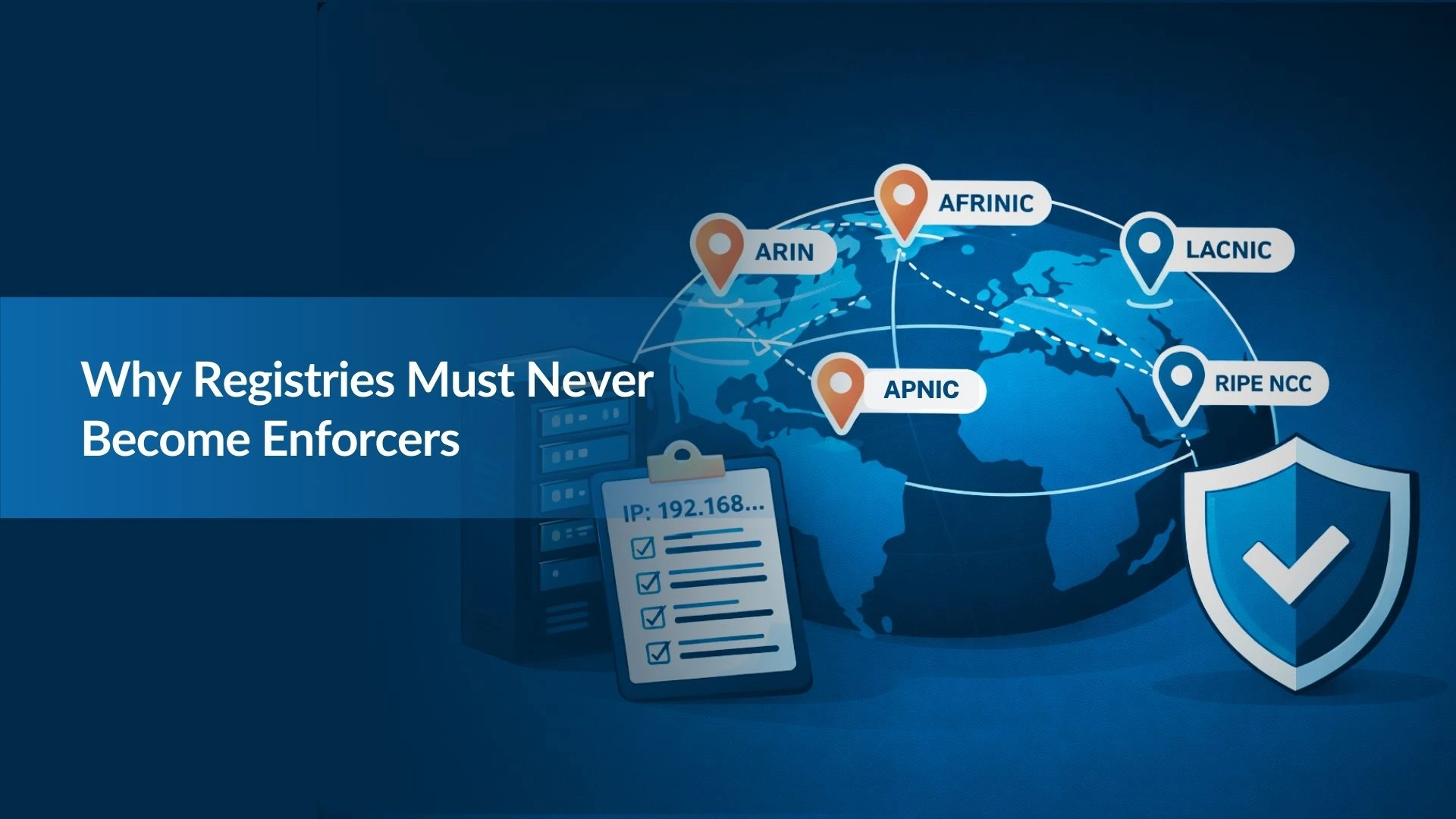
Today, the Internet’s most fundamental layer—IP address registration—remains centralised in the hands of five private Regional Internet Registries. Each holds a fragment of the global registration database, operates under a single national jurisdiction, and collectively costs hundreds of millions of dollars annually to maintain a system that is, in technical terms, trivial: a registration database measured in hundreds of megabytes. This structure introduces bureaucracy, inefficiency, geopolitical risk, and single points of failure into what has become critical global infrastructure.
The risks are not theoretical. Because RIRs are private entities subject to local law, their decisions can conflict with the interests or laws of dozens of countries in their service regions. Sanctions, political pressure, governance failures, or even financial distress at one registry can cascade into regional or national Internet outages. In recent years, registry actions have come uncomfortably close to disrupting Internet access for hundreds of millions of users. The current model assumes perpetual goodwill and perfect governance from institutions never designed to manage assets of this scale or strategic importance.
Distributed ledger technology offers a structurally different solution. Instead of a single authoritative database controlled by one organisation, each network would hold its own cryptographically verifiable record of its number resources, replicated across the Internet. Uniqueness—the only real value RIRs provide—would be guaranteed algorithmically, not institutionally. Resilience would be inherent: no single jurisdiction, company, or political event could alter or erase the global record.
The benefits are immediate and concrete. Registration and transfer processes, which today require weeks of manual intervention, could be automated and completed in milliseconds. Records would be permanent and immutable, removing the existential risk that a registry decision could destroy a company’s network or business. Ownership would be real: holding the token would mean controlling the address, not leasing it at the discretion of a third party in another country.
This shift also unlocks economic reality. IPv4 addresses already represent a market valued at over one hundred billion dollars, yet liquidity is absurdly low because ownership is not recognised. By moving IP registration onto a distributed ledger, addresses become fully tradable assets, comparable to other commodities. For telecom operators, IP holdings would finally be reflected accurately on balance sheets, potentially multiplying market capitalisation. This is not speculation; it is correcting a structural distortion.
Concerns about regulation are misplaced. Decentralisation does not eliminate sovereignty; it restores it. Governments retain full authority over operators within their borders, enforcing national law directly rather than indirectly through foreign private registries. Regulation becomes local and enforceable, instead of global, politicised, and fragile.
The RIR model worked when the Internet was small and addresses were plentiful. That era is over. IPv4 exhaustion and massive asset values have exposed the limits of centralised stewardship without accountability. Continuing to patch this model with more bureaucracy or intergovernmental control only compounds the problem.
We now have technology that did not exist when the Internet was founded. If we fail to decentralise the core, all higher-layer decentralisation—blockchain, Web3, digital identity—rests on a centralised foundation that can be captured or broken. Moving IP address registration to a distributed ledger is not ideological. It is a systems-level necessity if the Internet is to remain stable, neutral, and indivisible for the next hundred years.