

On Reality Layers, Symbolic Power, and Why Clarity Feels So Hostile
On Reality Layers, Symbolic Power, and Why Clarity Feels So Hostile Written by Lu Heng | 22 December 2025 CEO […]
On Reality Layers, Symbolic Power, and Why Clarity Feels So Hostile Written by Lu Heng | 22 December 2025 CEO […]
Why RIRs Do Not Have Authority — and Why “Community Sovereignty” Breaks the System Written by Lu Heng | 22
The claim that IPv4 could reach a total value of $60 trillion is not rhetorical. It follows from basic asset economics once IPv4 is treated for what it actually is: a scarce, irreplaceable service-enabling asset.
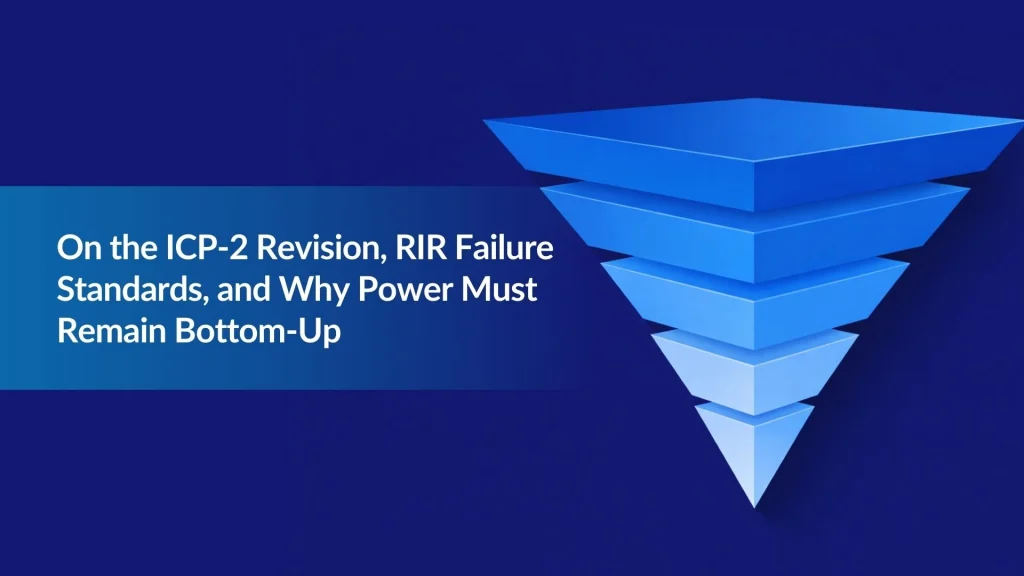
The revival of ICP-2, a document drafted over 20 years ago to define the criteria for establishing Regional Internet Registries, was triggered by the AFRINIC governance crisis—and rightly so.

Recently, many RIPE NCC members received an email titled “Download Review,” demanding confirmation of information within 48 hours. The email did not come from RIPE NCC. It was a phishing attempt, exploiting fear—specifically, fear of RIPE NCC’s perceived authority.

IPv4 is the Internet’s most important service enabler. A device or cloud server cannot be online without an IPv4 address. Yet IPv4 is priced as if it were negligible. At roughly $0.30 per month per IP, it enables services worth around $300 per month per server—about 0.1% of the value it makes possible. In any other market, critical enablers capture a meaningful share of the revenue they enable: city-center rent is often ~30% of a shop’s revenue because location is the enabler. By that logic, IPv4’s upper valuation potential is vastly higher than today’s.
IPv4 addresses remain one of the most undervalued assets in the global digital economy. Their suppressed valuation is not accidental; it is structural. And that suppression directly translates into suppressed valuations for ISPs and infrastructure businesses worldwide.
Today, the Internet’s most fundamental layer—IP address registration—remains centralised in the hands of five private Regional Internet Registries. Each holds a fragment of the global registration database, operates under a single national jurisdiction, and collectively costs hundreds of millions of dollars annually to maintain a system that is, in technical terms, trivial: a registration database measured in hundreds of megabytes. This structure introduces bureaucracy, inefficiency, geopolitical risk, and single points of failure into what has become critical global infrastructure.
The cost of running RIPE NCC has become a recurring controversy, and for good reason. To assess it properly, we must start from first principles: what a Regional Internet Registry actually does, and what it is supposed to do.
As APRICOT 2024 concludes, a few points stand out. It was valuable to engage directly with the community on issues shaping the global Internet, and the AGM marked a necessary turning point for APNIC after more than two decades of concentrated control.