The Internet’s Address Book — and Why “Digital Sovereignty” Is a Dangerous Fantasy
The Internet is often discussed as if it were a territory that can be owned, controlled, or conquered. This is a fundamental misunderstanding.
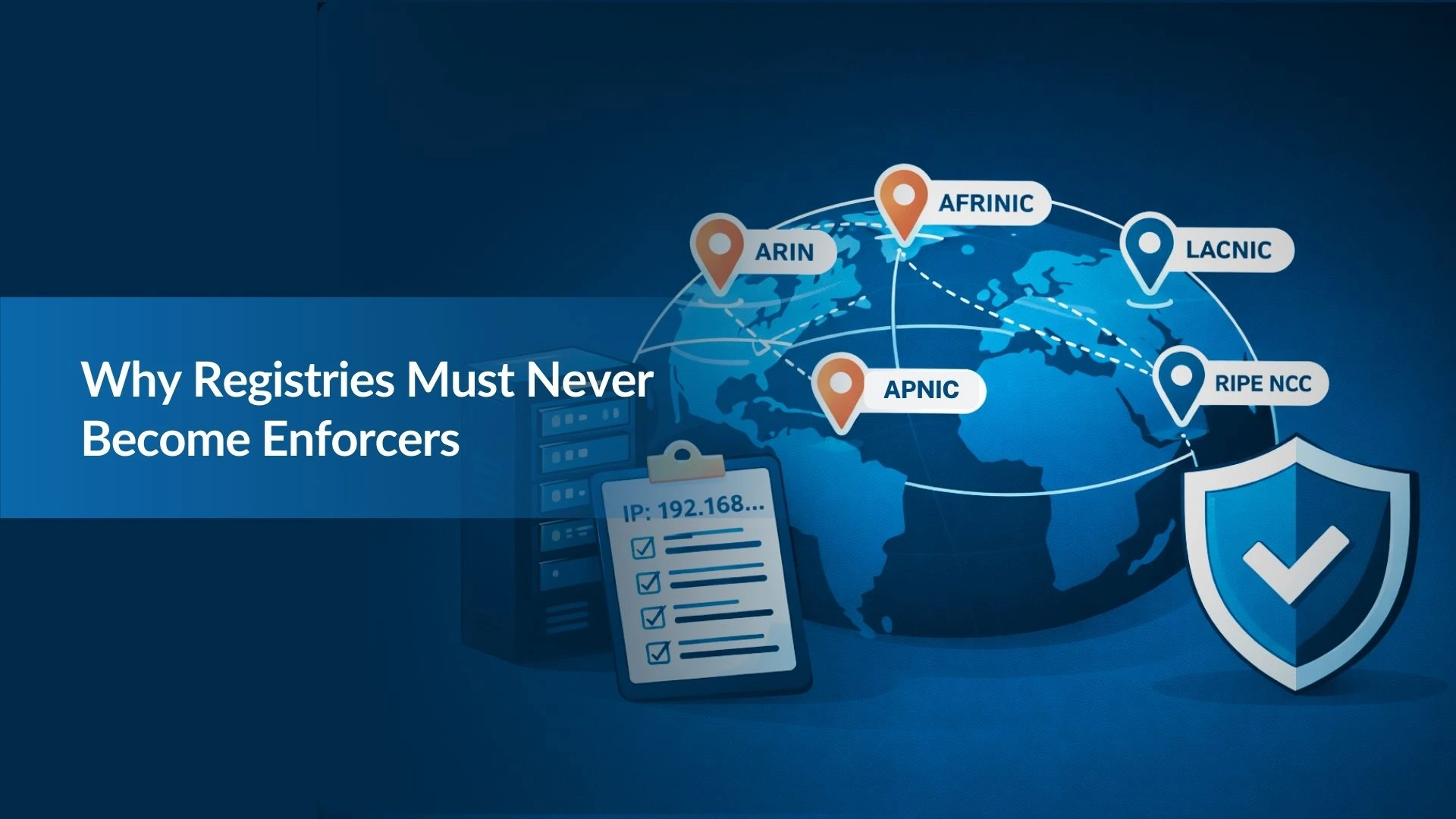
A useful analogy is a city. Every house needs an address so that people, mail, and services can reach it. On the Internet, computers and networks are the houses, and IP addresses are those addresses. As the city grows, someone must maintain a neutral address book—simply recording which number is in use by whom so that traffic can find its destination.
That is the sole function of Regional Internet Registries. AFRINIC, in Africa’s case, is nothing more than this: an address book.
The keeper of an address book does not own the houses.
He does not control the streets.
He does not command the residents.
He records numbers.
Once this is understood, the rhetoric of “digital sovereignty” collapses. The idea that one can control the African Internet by controlling AFRINIC is equivalent to believing that stealing a phone book gives you power over every phone call. It is not only wrong, but conceptually childish.
AFRINIC does not run the Internet. It does not control countries, networks, or users. It works only because networks voluntarily cooperate with a neutral registry. The moment it ceases to be neutral, it ceases to be trusted—and therefore ceases to function.
This distinction matters because recent years have seen attempts to politicize AFRINIC under the banner of “digital sovereignty.” That phrase sounds powerful, but it describes a fantasy. Africa is not a single political entity. It consists of 54 sovereign states with divergent legal systems, conflicting interests, and in many cases open geopolitical hostility toward one another. The notion that such a continent could accept a centralized “supreme digital authority” is detached from reality.
More importantly, the Internet itself is structurally incompatible with that vision. It was designed to be decentralized, permissionless, and resilient precisely because no single actor can command it. Trying to impose top-down political control on an address registry does not create sovereignty; it destroys trust. And without trust, the Internet fragments.
Our involvement in AFRINIC followed this logic, not a political agenda. When IP addresses serving hundreds of millions of end users were threatened with revocation without legal basis, the issue was not strategy but harm prevention. When AFRINIC entered a governance vacuum, the issue was not power but institutional survival. And when political influence began to interfere with court-ordered neutrality, the issue became constitutional: the separation of powers is not optional if an institution is to remain credible.
AFRINIC can only exist as a neutral librarian. The moment it is treated as a tool of state ambition or continental dominance, it becomes useless to the very networks it is meant to serve.
You do not rule the Internet by command.
You do not build it by force.
And you do not achieve “digital sovereignty” by politicizing an address book.
The Internet works because no one owns it. AFRINIC works only if it remembers that.